Ah, Poor Morro Bay. Last year the city hired Devin Weigant of Municipal Auditing Services (MAS) to pull an Inspector Javert on the city and track down anyone, including "outside vendors" who do business within the Morro Bay city limits and see if they have the proper business license. Weigant and MAS will get 40% of whatever monies he can shake out of the pockets of the business community.
The reason for the sudden enforcement of what has been, apparently, a lax and sloppily administered law, was the city is, well, broke-ish and needs mo’ money. But it turned out Inspector Javert’s ham-handed enforcement methods left a lot of business folks feeling insulted, threatened and, above all, totally confused and angry.
And now, Colin Rigley of New Times got his hands on 492 pages of emails between Weigant’s firm and the city staff, including the city’s new Manager, David Buckingham. And, being New Times, “The Shredder” had to chime in as well. I don’t think MAS will be amused. Neither will the good folks of Morro Bay when they read what Mr. Weigant had to say about them in those emails.
( http://www.newtimesslo.com/news/11955/clowns-and-weed-huts-new-times-reviews-hundreds-of-pages-of-emails-between-morro-bay-and-its-business-license-auditor/)
Well, who can blame them? The original roll out of this enforcement effort wasn’t ready for prime time. Even after some modifications, it still isn’t ready.
This is one of those ordinances that’s been on the books for years, wasn’t really widely known or diligently enforced, and needed considerable re-working and re-thinking before being turn-keyed. None of which happened here.
Instead, business owners woke up to what they perceived to be threats and bully-boy tactics when they tried to inquire or appeal. They were faced with totally confusing information (at an early public meeting, officials didn’t know whether the income parameters were for net or gross). They were also facing an ordinance filled with strange loopholes, exceptions, disparities that left the city staff scrambling to make patches, and soon these bungles started to reveal a poorly written and considered law that was filled with unintended consequences.
For example, the owner of one of the city’s consignment stores pointed out that her consigners really made so little selling their art or collectables that if they had to cough up big bucks for a license, they’d simply leave town and she’d be out of business. Artists chimed up to note that if they had a show in a Morro Bay gallery a couple of times a year, they’d be dinged with a huge bill for the license and 4 years of back fees, an untenable hit for an artist who may only sell a few pieces of work a year.
They too would leave town. After all, why would any artist bring their work to any gallery in town, when no other gallery in the county requires such an expensive license?
Realizing they were faced with some unintended consequences heading their way, the City Council created a second tier of fees for artists, small crafters, etc. But, I recently heard (unconfirmed) that thanks to some lobbying, musicians were now exempted while (visual) artists are still stuck with what could turn out to be fees totaling $160 just to hang a picture in town. If true, then clearly this cobbled together law still needs more work.
Meantime, Weigant & Co’s emails have done nothing to improve the mood of the Morro Bay business community. Calling them “scoflaws,” “child like” and “clowns” when they were just trying to make sense of, clarify and appeal what was so obviously a poorly written, confusing ordinance, is not a way to make friends or influence people.
And for a town that relies for so much of its tax money on small businesses, hiring MAS now looks like one of those penny wise, pound foolish desperate measures elected officials make when stressed over flagging budgets.
Instead of doing the hard work of consulting with and understanding the communities’ business structure in order to construct and perhaps amend and improve on previous ordinances to enhance both small business and the city’s coffers, they just grabbed at a rain-making Inspector Javert who came roaring into town promising that coins would fall out of the sky with little or no work on their part.
Knowing Morro Bay Politics, it’s a choice that’s likely to have consequences --unintended, many of them unhappy, few of them necessary. But then, in a city filled with “clowns,” what can you expect?
Monday, February 02, 2015


Sunday, February 01, 2015
Sunday Morning

We are all looking for something of extraordinary importance whose nature we have forgotten.
Eugene Ionesco
Saturday, January 31, 2015
Shooter’s Gallery
The movie, “American Sniper,” has certainly stirred up a whole lot of voices. That's good. And, like most of America, the opinions being expressed are both polarized and all over the map. But two general themes keep turning up: Chris Kyle, a Navy SEAL and an Iraq War sniper portrayed in the film, was a " hero" or a "villain," a brave soldier or a cowardly sciopathic killer. And the movie was a pro-war Hoo-rah! screed or a powerful anti-war film.
These simple black and white designations always diminish and disguise the complicated reality of soldering and war. The propensity of calling anyone who did their duty a “hero” seems to be a recent outcome of a culture that gives out gold stars and trophies to kids who just showed up so as to not wound their tender sense of self-esteem.
And calling a soldier a villain blames the instrument for the policy and neatly sidesteps responsibility. If you hate the war and blame the soldier, that conveniently avoids the unpleasant truth that in a democracy the creator of the war, the architect of the policy, will be found smack dab in the middle of a mirror.
And calling a sniper or a combat soldier a sociopathic killer gravely misses one of the terrible truths about war. And that’s actor George C. Scott's "Patton-ish"speech from the movie, "Patton," the bitterly funny line, "I want you to remember that no bastard ever won a war by dying for his country. He won it by making the other poor, dumb bastard die for his country."
That awful truth is what made Michael Moore’s comment about snipers in general being viewed as “cowardly” so fatuous. In combat, while taking care to stay within the rules of engagement, how your enemy dies is immaterial. Sniper’s bullet, face-to-face firefights, rocket strikes, bombs, or a knife in the gut is immaterial. Dead is dead and a soldier’s job is to create sufficient dead enemy so that they stop shooting and quit the field of battle. Do that enough times and if you’re lucky, the war may end and you'll get to go home. Alive.
All of which gets very, very complicated in wars where the enemy is not in uniform all neatly turned out into organized battalions lined up on an open plain, flags flying. Asymetrical warfare, guerilla warfare, civilian combatants are ugly, nightmare complications that put extraordinary demands on soldiers. Misread a situation and in a split second a soldier can be dead, or headed for a court martial. And even if all goes well, bloody combat, by its very nature, is too often soul-wounding and puts hard baggage on the survivors. "After such knowledge," observed T.S. Elliot, "what forgiveness?"
In addition, our modern wars conducted by a small cadre of chronically overburdened professional soldiers puts extraordinary demands on those men and women and their families. Too often, we have carelessly and recklessly given them an impossible mission and when the mission fails, we turn our backs and walk away. Or call them cowards or heroes so we don’t have to look more deeply at the complexities behind those words.
“American Sniper” has started a “conversation,” which is good. I can only hope that that “conversation” yields some positive results, a better understanding, more honest evaluations and wiser choices going forward.
Before America slips into its typical default mode: The Great Forgetting.
These simple black and white designations always diminish and disguise the complicated reality of soldering and war. The propensity of calling anyone who did their duty a “hero” seems to be a recent outcome of a culture that gives out gold stars and trophies to kids who just showed up so as to not wound their tender sense of self-esteem.
And calling a soldier a villain blames the instrument for the policy and neatly sidesteps responsibility. If you hate the war and blame the soldier, that conveniently avoids the unpleasant truth that in a democracy the creator of the war, the architect of the policy, will be found smack dab in the middle of a mirror.
And calling a sniper or a combat soldier a sociopathic killer gravely misses one of the terrible truths about war. And that’s actor George C. Scott's "Patton-ish"speech from the movie, "Patton," the bitterly funny line, "I want you to remember that no bastard ever won a war by dying for his country. He won it by making the other poor, dumb bastard die for his country."
That awful truth is what made Michael Moore’s comment about snipers in general being viewed as “cowardly” so fatuous. In combat, while taking care to stay within the rules of engagement, how your enemy dies is immaterial. Sniper’s bullet, face-to-face firefights, rocket strikes, bombs, or a knife in the gut is immaterial. Dead is dead and a soldier’s job is to create sufficient dead enemy so that they stop shooting and quit the field of battle. Do that enough times and if you’re lucky, the war may end and you'll get to go home. Alive.
All of which gets very, very complicated in wars where the enemy is not in uniform all neatly turned out into organized battalions lined up on an open plain, flags flying. Asymetrical warfare, guerilla warfare, civilian combatants are ugly, nightmare complications that put extraordinary demands on soldiers. Misread a situation and in a split second a soldier can be dead, or headed for a court martial. And even if all goes well, bloody combat, by its very nature, is too often soul-wounding and puts hard baggage on the survivors. "After such knowledge," observed T.S. Elliot, "what forgiveness?"
In addition, our modern wars conducted by a small cadre of chronically overburdened professional soldiers puts extraordinary demands on those men and women and their families. Too often, we have carelessly and recklessly given them an impossible mission and when the mission fails, we turn our backs and walk away. Or call them cowards or heroes so we don’t have to look more deeply at the complexities behind those words.
“American Sniper” has started a “conversation,” which is good. I can only hope that that “conversation” yields some positive results, a better understanding, more honest evaluations and wiser choices going forward.
Before America slips into its typical default mode: The Great Forgetting.
Monday, January 26, 2015
Foxcatcher
"Foxcatcher" is a tragic creepshow, a sorrowful horror movie, a sad, scary suspense thriller that grimly unwinds with increasing fateful urgency towards its unstoppable, heartbreaking end.
Steve Carell, who usually plays sad-sack comic roles, plays John E. ("Eagle") DuPont, one of the richest men in the world, scion of the DuPont family, a sad, damaged man-child with Mommy issues, too much money, a social awkwardness that is heartbreaking, self esteem that's delusional, and a mind that's unsettled and unraveling. Carell's performance is astonishing, his face nearly unrecognizable under a new nose and teeth. But it's his performance that keeps the viewer riveted by the man at the awful center of this sad drama -- a clumsy, cringe-worthy, socially disconnected, decidedly odd man, his body movements slack and disorganized, his flat, affectless face and inappropriate conversation inept and disconcerting. For the viewer, Carell's behavior becomes increasingly alarming since anyone familiar with the story knows that this is a tale that is fated to end badly. But because nobody in the theatre knows just exactly when that will be, the suspense builds to an unnerving level.
The other two players in this tragic troika, are Mark and Dave Schultz, played by Channing Tatum and Mark Ruffalo respectively. As presented, they too are damaged, trouble souls whose ambitions and dreams and emotional needs were ripe for DuPont's picking. Initially Mark, a needy man resentful being in the shadow of his older brother, is lured to Foxcatcher Farms, the DuPont estate, by DuPont, who fashions himself a coach and "leader of men," and who's built an elaborate wrestling training camp, created "Team Foxcatcher," and wants to become the premier center for all US wrestling teams.
Initially, the relationship between Mark, DuPont and the formation of the "Team Foxcatcher" goes well, with Mark winning at the World events and everyone working towards the 1988 Olympics. Eventually, Mark's older brother is lured to join the enterprise. He uproots his family and moves them to Foxcatcher Farms to join his brother and the team as a coach. It is a deadly Fata Morgana for both of them.
"Foxcatcher" is one of those films that's difficult to watch because the viewer is as helplessly trapped in its relentless narrative as are the characters -- no way out, this tragedy must play out to the end. But Carell, Tatum and Ruffalo's amazing performances makes the horrifying trip well worth it. It won't be a surprise if there isn't Oscar gold here for these remarkable performances and for Director Bennett Miller for creating such a powerful, haunting, well made film.
Steve Carell, who usually plays sad-sack comic roles, plays John E. ("Eagle") DuPont, one of the richest men in the world, scion of the DuPont family, a sad, damaged man-child with Mommy issues, too much money, a social awkwardness that is heartbreaking, self esteem that's delusional, and a mind that's unsettled and unraveling. Carell's performance is astonishing, his face nearly unrecognizable under a new nose and teeth. But it's his performance that keeps the viewer riveted by the man at the awful center of this sad drama -- a clumsy, cringe-worthy, socially disconnected, decidedly odd man, his body movements slack and disorganized, his flat, affectless face and inappropriate conversation inept and disconcerting. For the viewer, Carell's behavior becomes increasingly alarming since anyone familiar with the story knows that this is a tale that is fated to end badly. But because nobody in the theatre knows just exactly when that will be, the suspense builds to an unnerving level.
The other two players in this tragic troika, are Mark and Dave Schultz, played by Channing Tatum and Mark Ruffalo respectively. As presented, they too are damaged, trouble souls whose ambitions and dreams and emotional needs were ripe for DuPont's picking. Initially Mark, a needy man resentful being in the shadow of his older brother, is lured to Foxcatcher Farms, the DuPont estate, by DuPont, who fashions himself a coach and "leader of men," and who's built an elaborate wrestling training camp, created "Team Foxcatcher," and wants to become the premier center for all US wrestling teams.
Initially, the relationship between Mark, DuPont and the formation of the "Team Foxcatcher" goes well, with Mark winning at the World events and everyone working towards the 1988 Olympics. Eventually, Mark's older brother is lured to join the enterprise. He uproots his family and moves them to Foxcatcher Farms to join his brother and the team as a coach. It is a deadly Fata Morgana for both of them.
"Foxcatcher" is one of those films that's difficult to watch because the viewer is as helplessly trapped in its relentless narrative as are the characters -- no way out, this tragedy must play out to the end. But Carell, Tatum and Ruffalo's amazing performances makes the horrifying trip well worth it. It won't be a surprise if there isn't Oscar gold here for these remarkable performances and for Director Bennett Miller for creating such a powerful, haunting, well made film.
Sunday, January 25, 2015
The Tipsy Great Vine Gets Righted
The Roger’s Red Great Grape Vine was getting so big and the fence posts so rotten, that it was threatening to tip the whole fence over. So, the vine was pruned back rather severely.

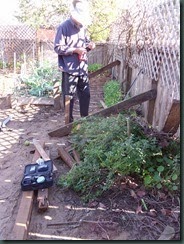
My friend and neighbor, Phil, who knows how to fix things properly, arrives.
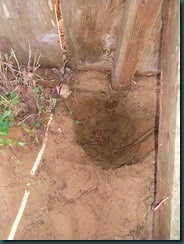
The fence is braced and the post holes are dug.
The tall metal new posts are inserted and pounded into place. When the lattice or the fence itself needs replacing, the poles will still serve as a quasi arbor to support the vine’s arms.

And braced with metal straps.

The concrete is mixed and dumped.
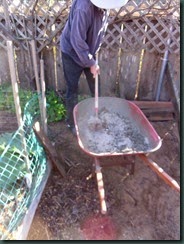
Below is a shot of the highly skilled expertise and critical technical assistance I brought to this whole project.


VOI LA! Now I wait for rain and soon The Great Vine will awaken and spread her glorious leaves all over a sturdy , upright fence. And I will dream of savoring sips of fierce, intense, ruby-red grape juice come summer.

My friend and neighbor, Phil, who knows how to fix things properly, arrives.

The fence is braced and the post holes are dug.

The tall metal new posts are inserted and pounded into place. When the lattice or the fence itself needs replacing, the poles will still serve as a quasi arbor to support the vine’s arms.

And braced with metal straps.

The concrete is mixed and dumped.

Below is a shot of the highly skilled expertise and critical technical assistance I brought to this whole project.


VOI LA! Now I wait for rain and soon The Great Vine will awaken and spread her glorious leaves all over a sturdy , upright fence. And I will dream of savoring sips of fierce, intense, ruby-red grape juice come summer.
Subscribe to:
Posts (Atom)




 Posts
Posts